I cannot talk about myself all the time. I get tired of endless me. (And I am pretty sure the next entry will again be me-centric.) For now, let us delve into the stories of others.
You have two options. You can listen to it and let there be a pre-Easter, miraculous theme to it.
Or, you can read the stories below. Stories where people lived. Where things went horribly, upside-down, topsy-turvy, and yet folks still lived to tell their tales.
Ernest Shackleton was quite the adventurer. He had tried to be the premiere explorer of Antarctica but had his plans foiled twice. He came up with a new goal: to be the first to cross the seventh continent on foot. (With some help from sled dogs.) He placed an ad in the newspaper stating, “safe return- unlikely” and he received over five thousand applicants.
Things went wrong. He and his twenty-six men found that their ship, the Endurance, got stuck in the ice. They waited many months for a thaw or a break or some way to get their ship free. Eventually, they packed up what they needed, got into their three lifeboats, and tried to go home.
Their hands froze to the oars. Antarctica is a land of negative-seventy-degree temperatures and one hundred miles per hour winds. One of the deadliest deserts on earth. They rowed and rowed and rowed. They were using a sextant and it took four days for the sun to poke through the gray clouds. On the fourth day, they checked their position and found that they had not gained an inch. Despite all their rowing, they had been sent back thirty miles.
They rowed for three more days. They finally made it to Elephant Island. It had been four hundred and ninety-seven days since they had been on land. Ernest Shackleton had his carpenter reinforce the best of the lifeboats. He had five of his men crew the boat with him. Three would be rowing and navigating, while three would “rest” in a five by seven space below deck with water sloshing around them. Before they left, Shackleton told his officer,
“Convey my love to my people and say that I tried my best.”
He struck out for the whaling stations on South Georgia Island, eight hundred miles away, through the roughest waters on earth. They rowed and rowed for fifteen days until they saw land. That night, there was a hurricane. They would not land until the seventeenth day. Their trip is still regarded as one of the greatest open boat journeys.
On South Georgia Island, the whaling stations were on the opposite side. They took woodscrews from the lifeboat, put them in their shoes, and with their thin clothing, they set out to be the first to hike the thirty miles across mountain terrain in search of help. The three men stood at the top of a mountain and decided they would simply slide themselves down. They covered two thousand feet in a matter of minutes. After twenty-seven hours of hiking, they heard the seven-a.m. work whistle. Their trek had taken thirty-six hours.
It took Shackleton and his small crew three tries and four months to reach the twenty-one stranded men. As the boat neared the stranded crew, Shackleton stood up and counted the figures. He turned to his officer and said,
“They’re all there, skipper. They’re all safe.”
Tsutomu Yamaguchi was just doing his job. He and his two coworkers completed their three-month assignment in Hiroshima and were headed home. Yamaguchi forgot a piece of ID, turned back to get it, and was walking near the docks when the Enola Gay dropped its atomic bomb less than two miles away. He dove to the ground, rolled into an irrigation ditch, and tried to cover up as best as he could. The ear-shattering noise ripped through the air. He was tossed up as a fireball imploded overhead. A woman who had been walking next to him was vaporized. His eardrums were ruptured, he was temporarily blinded, and he acquired serious burns on the left half and top part of his body. Eventually, he met his two coworkers, found out that the trains were somehow still running, and made it back to work three days later, August ninth.
At eleven a.m., back in Nagasaki, he was describing his ordeal to his supervisor, who claimed that Yamaguchi must have made up the story. The office lit up with the brightness of an explosion and Yamaguchi hit the floor as a result of the second atomic bomb, Little Boy. two hundred and twenty-six thousand people were killed in the two bombings. Yamaguchi is the only survivor to be officially recognized by his government, but details point to one hundred and sixty-five people surviving both bombs.
After the bomb in Nagasaki, Yamaguchi ran home to find his home turned to rubble. His wife and child had been out buying him medicine for his radiation burns. If Yamaguchi had not been injured in Hiroshima, his family might not have survived the Nagasaki bombing.
On January twenty-sixth, nineteen seventy-two, a terrorist bomb went off in a plane flying over what is now the Czech Republic. Thirty-three thousand, three hundred, and thirty-three feet above ground, the plane broke into three pieces. With the cabin depressurized, it is likely that the crew and passengers were sucked out of the plane into freezing temperatures, falling to their death.
Vesna Vulovic should not have been on the plane. When they were assembling the flight crew, the airline made a mistake. They had two employees named Vesna. But Vesna Vulovic had never been to Denmark, and the twenty-three-year-old decided to take the assignment. Which is how Vulovic wound up pinned to the back of the fuselage, caught behind a food service cart. However, she never should have been hired on. She had low blood pressure. She drank coffee before her interview to overcome the test results. When the plane erupted, her low blood pressure caused her to pass out. Her body didn’t fight the six-mile, three-minute fall to the ground. It is also believed that her low blood pressure kept her heart from bursting upon impact.
As for the crash itself- the flatness of the fuselage caused it to slow as it fell. The trees that it hit slowed the descent. It all ended with the plane landing in thick snow at a favorable angle. Vulovic was discovered by a local, Bruno Honke, who had been a World War II medic. He had over thirty years’ experience in the field of medicine. While Vulovic suffered many injuries from the crash, she would eventually go back to work at the airline, walking with a limp.
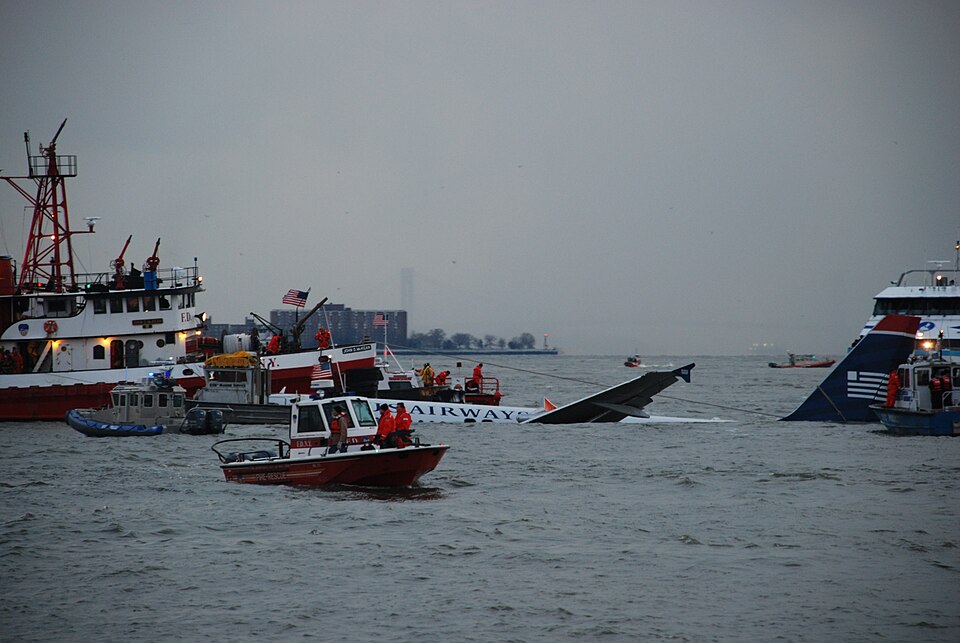
US Airways Flight 1549 should have been a quiet flight. One hundred and fifty-five people on board. Experienced pilots. A full crew. Then, minutes after their take off, for the first time in aviation history, both engines were taken out when they were struck by birds. Captain Sully would later state, “It felt like the forward motion stopped in midair.”
The temperature was only thirty-six degrees. The wind chill factor made it feel like negative five. And yet they had to navigate a forced water landing. The flight, from takeoff to landing, took two hundred and eight seconds. The engines went out at twenty-eight hundred feet, the lowest altitude ever. If Sully had operated by protocol, things would have been worse. Water landings do not go well for planes. Hypothermia, the fragility of nose cones, the physics of giant wings smacking into sea. Sully skipped fourteen steps. He used his experience. And because the right person was in the right spot at the right time, we remember the incident as the Miracle on the Hudson. Sully offered,
“I hope they know that I did the best I could.”


Leave a comment